Do you craft and deliver engaging presentations?
Loading last updated info...
Giving a live presentation in front of an audience can be daunting, whether online or in person. It can also be a thrilling and rewarding experience when you do it well. In order to achieve a great result, presenters should prepare.
Study about presenting
A good starting point is to watch "7 Deadly Presentation Sins" presentation. In this session Samantha and Andrew Coates demonstrate seven sins that must not be committed in a presentation, why and how a presentation can suffer from committing them, and how to avoid accidentally committing them.
Video: 7 Deadly Presentation Sins with Andrew & Samantha Coates (1 hr 16 min)
Read these articles:
You should also consider taking the course Speaking Confidently and Effectively.
Make time for adequate preparation
Structure & learn your content well and then rehearse the delivery for a given audience and context until you are getting it right more often than you are getting it wrong. Don’t wait until the last minute! If you are well prepared you can focus on your delivery instead of worrying about knowing your content or running a demo.
❌ Video: Bad example – Ill prepared and low energy. They show you how to fix it, though (5 min)
✅ Video: Good example - A well prepared presentation with an excellent delivery (1 hr 9 min)
Be understood
Make the effort to be understood, speak clearly, and check for understanding as you go along, even if you can't hear the audience.
For more information read about identifying your audience knowledge level
Build resilience in high-pressure situations
Gain repeated exposure to high-pressure situations - staying cool and dealing with problems as they arise without derailing yourself or the audience.
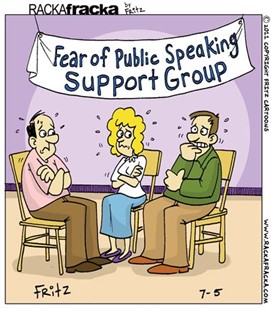
Figure: The only way to get comfortable speaking... is to start speaking
Know mistakes happen and that's OK
Even the most practiced presenters will slip up, but what separates professionals from amateurs is how you deal with it.
Time seems to slow down under pressure situations, but only for you! It doesn’t matter if you take a few moments to figure out the problem, your audience won’t be phased at all, just give them respect and ask them for patience and it will be granted automatically.
Aim for a strong delivery
Presentation delivery is about effectively engaging your audience, maintaining their attention, and guiding them through key points. A polished delivery can make even simple content memorable, leaving a lasting impression on listeners.
A good way to achieve a strong delivery is to avoid using filler and non-words. Watch this video to get rid of your "umms" and "ahhs":
✅ Video: Good example - Using silence to strengthen your message (1 min)
Engage your audience
Ask your audience questions audience members questions during your presentation. Even simple yes or no questions can make the audience feel like they're part of the conversation. For example, consider asking for a show of hands.
Use AI to help you prepare
AI can be useful for both preparing and testing your presentation. While never a substitute for a real human, it can be a sounding board for general structure, talking points, and flow. Use it to help build your first draft, before putting it in front of other subject matter experts (SMEs) for feedback.
AI practice tools
While the usual suspects (GPT, Claude, etc.) are good for content and structure, they can't assess or provide feedback on your performance. Instead, you should use more presentation-specific tooling that can measure your delivery, tone, and eye contact. Some useful tools in this area are:
Extra tips: Scott Hanselman, a very well-known Microsoft public speaker, gave these tips in his Pluralsight course: The Art of Speaking: Scott Hanselman.
- Consider attire vs background - make sure there's contrast
- Don't touch your face
- Don't put your hands in your pockets, or if you do, don’t have keys in your pockets
- Don't rock back and forth
- If you’re moving, move deliberately
- When you're walking, they’ll look at you
- When you stop and turn, they’ll look at the slides
- Stay focused on the topic. Don’t just ramble on
- Put yourself in the audiences shoes
- Can they see and hear you?
- Can they read your screen?
- Be prepared for demo failures