Do you use online regex tools to simplify your regular expression workflows?
Loading last updated info...
Regular expressions (regex) are powerful tools for pattern matching and text processing, but they can be challenging to write and debug. Online regex tools like RegExr and Regex101 simplify this process by providing interactive environments to test, debug, and learn regex. These tools save time, reduce errors, and help you master regex faster.
Why use online regex tools?
- Instant Feedback: Test your regex patterns in real-time and see immediate results
- Learning Resources: Many tools include tutorials, examples, and explanations to help you understand regex syntax
- Debugging Features: Identify issues in your regex with visual aids and detailed error messages
- Cross-Platform: These tools are accessible from any browser, making them convenient for developers on the go
import re# Define the regex pattern for validating passwordspattern = r"^(?=.*[a-z])(?=.*[A-Z])(?=.*\d)(?=.*[!@#$%^&*()_+\-=\[\]{};':\"\\|,.<>\/?]).{8,}$"# List of passwords to validatepasswordList = ["A1b2C3d4!","S3cur3#Key","Pass!","Password1","password!1","A1b2C3d4!"]# Loop through the passwords and use re.search to validate themfor password in passwordList:if re.search(pattern, password):print(f"Valid: {password}")else:print(f"Invalid: {password}")
Valid: A1b2C3d4!Valid: S3cur3#KeyInvalid: Pass!Invalid: Password1Invalid: password!1Valid: A1b2C3d4!
❌ Figure: Writing and testing regex directly in your code without live validation
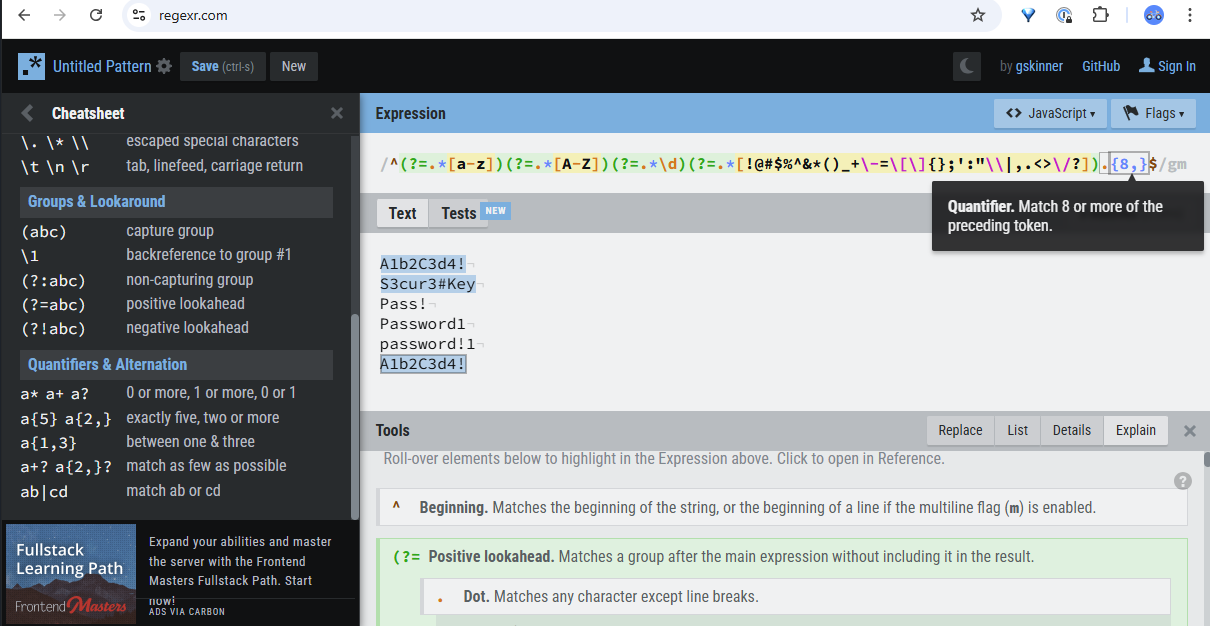
✅ Figure: Using RegExr to debug and validate your pattern before implementation
Best Online Regex Tools
- RegExr (Recommended)
- User-friendly interface and community-driven examples.
- Open source and can be hosted privately. See https://github.com/gskinner/regexr/
- Regex debugger to step through your pattern.
- Code generator for multiple programming languages.
- Extensive regex library and quick reference guide.
Avoid overcomplicating your regex patterns; use the tools to simplify and optimize them.