Do you know how to find broken links?
Loading last updated info...
Often times, web pages are dynamic. Most link scanners are not capable of submitting form information. The trick is to allow a "door" for link scanner go through to scan a dynamic section of a site. A common technique is to hard code hidden link with a query string at the bottom of the page that allows the link scanner to follow into the simulated user input. See the following code for example:
<a href="KB.aspx?KBID=Q1097707">Q1097707 - How do I turn Option Strict on by default in VB.NET?</a>
Figure: Example source code - finding broken links
It will return all the knowledge base articles in a paged format. The link scanner will click the Next Page link and eventually scan through the entire knowledge base.
Google Webmaster & Bing Webmaster
Google webmaster tools and Bing webmaster centre are useful tools to monitor links.
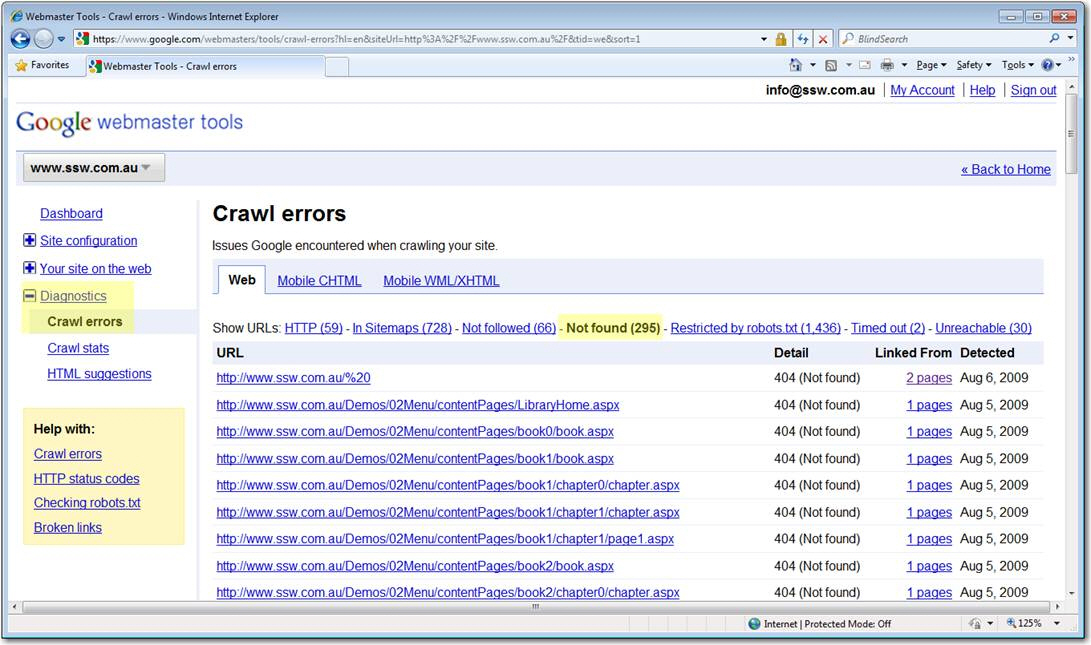
✅ Figure: In Google webmaster tools you can see all broken URLs, and even the pages who are linking to them (known as referrer, found in the 'Linked From' column)
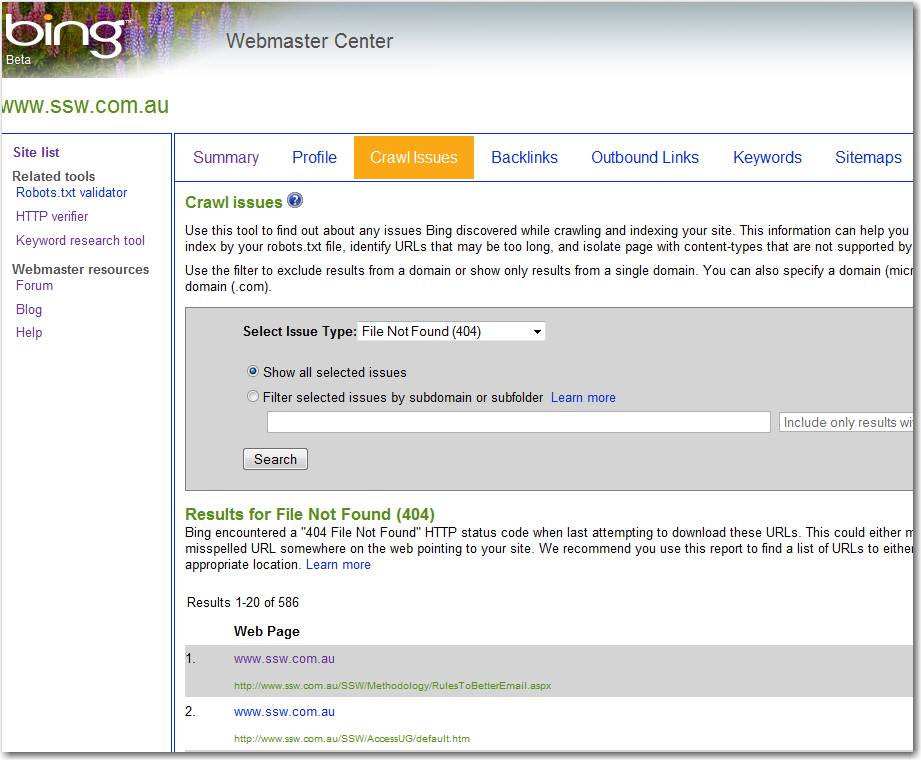
Figure: In Bing webmaster centre you can find the broken URL which is linked by the above URL
SSW Link Auditor
We have a program called SSW Link Auditor to check for this rule.
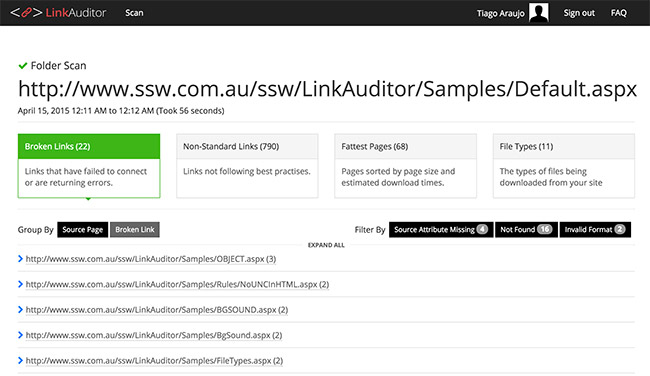
✅ Figure: SSW Link Auditor automatically locate broken links
SSW CodeAuditor
Identifying where you have broken links on your website can be a little like finding a needle in a haystack. For enterprise scale web applications with lots of moving parts, it feels more like finding a penny at the bottom of the ocean.
SSW CodeAuditor is a cheap, convenient tool for hunting down broken links, and you don't need a sitemap to set it up. Just point it at a publicly accessible URL and it'll spit out a report.
- Broken links are categorized by page making them easy to fix
- Each broken link listing includes a status code to tell you what went wrong
- Broken Links in the dashboard are displayed with their corresponding anchor text to give you some context about the page
- It can be implemented with you website's Continuous Integration pipeline using GitHub Actions
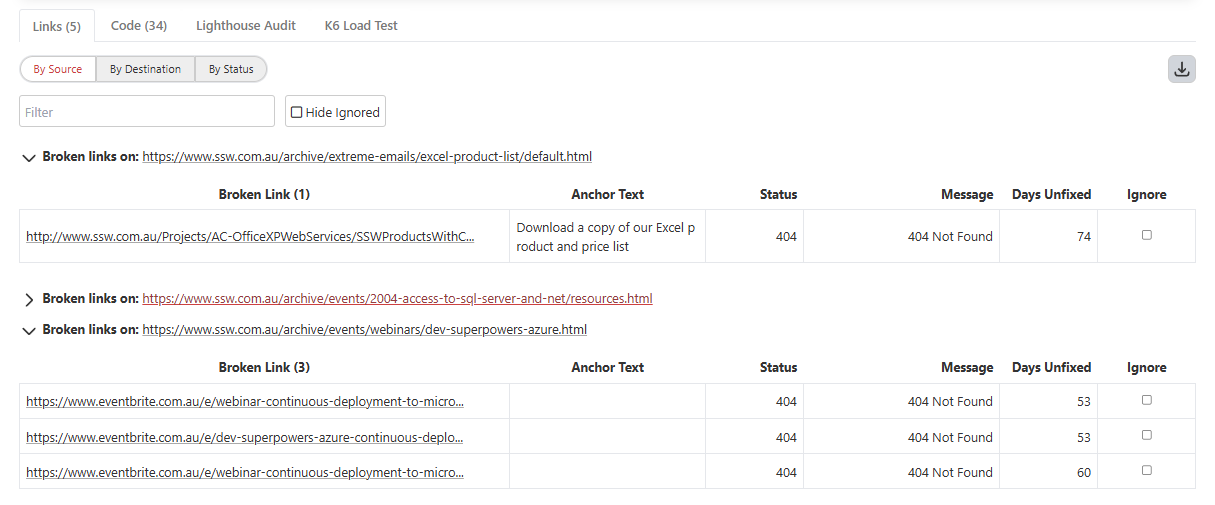
✅ Figure: Using SSW Code Auditor's broken link dashboard